international calling · 19 min read
Australian Phone Number Format Explained
Learn the Australia phone number format — country code +61, state area codes, and how to dial from the US. A complete guide for businesses and callers.
Australian phone numbers follow a clean, predictable structure once you know the rules: a single leading 0 trunk prefix at home, the country code +61 abroad, four single-digit geographic area codes, and a dedicated 04 range for mobiles. For any US business that calls, texts, or supports customers in Australia, getting the format right is the difference between a connected call and a dead line.
This guide breaks down the complete Australia phone number format — country code, state area codes, mobile versus landline, toll-free ranges, and emergency numbers — with a focus on what US-based teams need to dial correctly. For the step-by-step version of placing the call, see our companion guide on how to call Australia from the US.
What Is the Australian Phone Number Format?
Every Australian phone number has two valid written forms: a national (domestic) format used inside Australia, and an international format used from anywhere else in the world. The only structural difference between them is how the leading digit is handled.
In national format, an Australian number begins with a single leading 0. This 0 is the trunk prefix — it tells the Australian network that the digits that follow are a full national number rather than a local extension. After the trunk 0 comes either a geographic area code or a mobile prefix, and then the subscriber’s local number.
In international format, that leading 0 is dropped entirely and replaced by the country code +61. So the same physical line has one presentation for Australian callers and another for everyone dialing in from overseas. Understanding this single swap — 0 at home, +61 abroad — resolves the majority of Australian dialing confusion.
Here is the pattern at a glance for the two most common number types:
| Number type | National (in Australia) | International (from abroad) |
|---|---|---|
| Landline (Sydney) | 02 9876 5432 | +61 2 9876 5432 |
| Landline (Melbourne) | 03 9876 5432 | +61 3 9876 5432 |
| Mobile | 0412 345 678 | +61 412 345 678 |
Landlines total ten digits in national format: the leading 0, a single-digit area code, and an eight-digit local number. Mobiles also total ten digits in national format: 04 followed by eight more digits. The consistency is helpful — once you can recognize the leading 0 and the digit that follows it, you can classify almost any Australian number on sight.
For a US business, the practical takeaway is to standardize on the international +61 format everywhere numbers are stored — in your CRM, your dialer, your email signatures, and your website. E.164 (+61… with no leading 0) is unambiguous and routes correctly from any origin, which removes the guesswork from cross-border calling.
It also helps to think of the leading 0 as a display-only convention rather than part of the “real” number. The canonical identity of an Australian line is its +61 form; the 0 is simply the local dialing shortcut that Australians add when they are already inside the country. Framing it this way makes the drop-the-zero rule feel natural instead of arbitrary — you are not deleting a digit, you are choosing the international presentation of the same number.
This framing also explains why spacing varies between the two forms. Australians commonly write a landline as (02) 9876 5432 with the area code in parentheses, mirroring the way US numbers bracket their area code. In the international form the parentheses disappear and the spacing regroups around the country code, giving +61 2 9876 5432. The digits are identical; only the presentation shifts to suit the audience reading the number.
The Australia Country Code (+61)
Australia’s country code is +61. It sits at the front of every internationally formatted Australian number and is the anchor that tells global networks where the call is headed. The + symbol is shorthand for “insert your local international exit code here.”
When you dial from a specific country, you replace that + with your own country’s exit code. From the United States, the international exit code is 011. So the +61 you see written on an Australian business card becomes 011 61 when you actually key it into a US phone.
Australia’s own exit code — used when someone in Australia calls out to another country — is 0011. There are legacy alternatives (0018 and 1440) that some older services still recognize, but 0011 is the standard modern exit code for outbound international calls from Australia. You only need this if you or your team are physically in Australia calling elsewhere.
To keep the two directions straight:
| Direction | Prefix used | Example skeleton |
|---|---|---|
| Calling into Australia from the US | 011 (US exit) + 61 | 011 61 2 xxxx xxxx |
| Calling out of Australia to elsewhere | 0011 (AU exit) + country code | 0011 1 xxx xxx xxxx (to US) |
The +61 code covers mainland Australia along with its principal internal territories. Australia’s offshore external territories use separate arrangements, but for virtually all business calling — every state capital and major market — +61 is the code you need.
It is worth internalizing the direction each prefix serves, because the two exit codes look similar and are easy to swap. 011 is what a caller in the US keys to leave the US; 0011 is what a caller in Australia keys to leave Australia. Neither is part of the destination number itself — both are “doors out” of the calling country. Once the call is out, +61 (for Australia) or +1 (for the US) points it at the right national network.
A useful mental model is that + is a placeholder your device or carrier fills in with the correct local exit code. When you save a contact as +61 4xx xxx xxx, a phone in the US expands the + to 011, a phone in the UK expands it to 00, and a phone in Australia recognizes it as domestic. That single stored format therefore dials correctly from every country, which is exactly why E.164 storage is the recommended default for any team that operates across borders.
The golden rule with +61 bears repeating because it is the error that breaks the most calls: when you use +61, you must drop the national leading 0. The country code and the trunk 0 do the same job — signaling that this is a national-level number — so using both is redundant and invalid. +61 2 9876 5432 is correct; +61 02 9876 5432 is not.
Australian State Area Codes
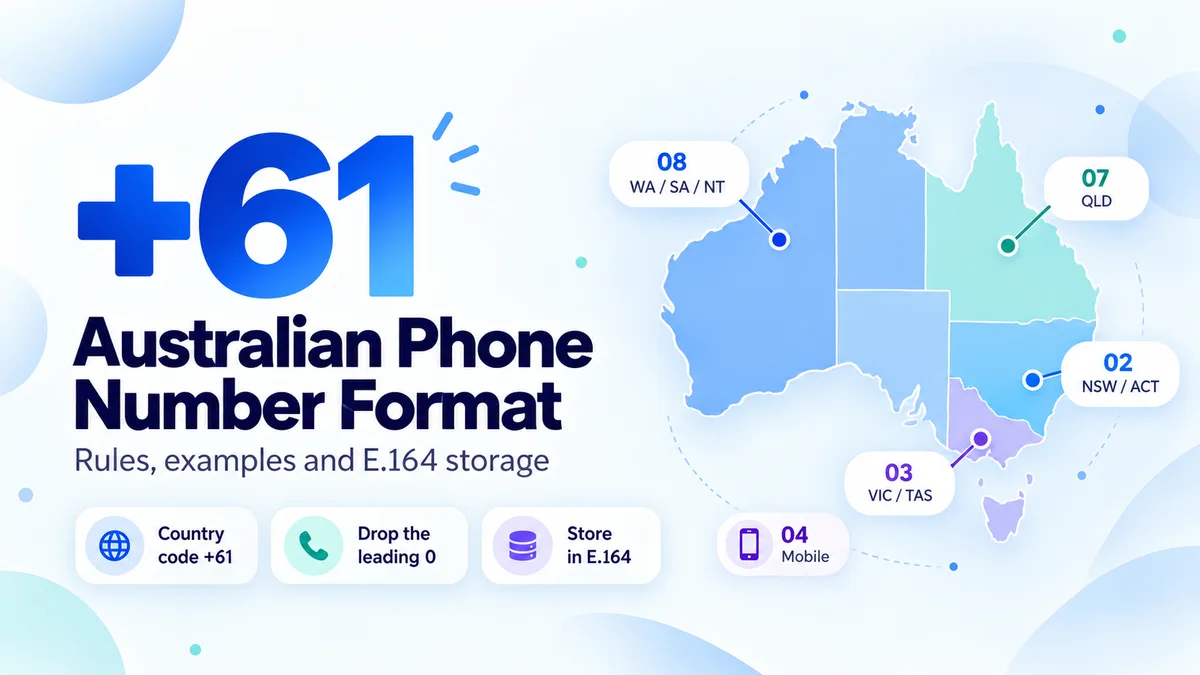
Australia uses just four geographic area codes, each a single digit that appears immediately after the leading 0. This is far simpler than the US system of hundreds of three-digit area codes. Each Australian code maps to a broad region rather than a single city, so a single area code can cover an entire state or several territories.
Here is the complete geographic area-code map:
| Area code (national) | International form | States / territories covered | Major cities |
|---|---|---|---|
| 02 | +61 2 | New South Wales, Australian Capital Territory | Sydney, Canberra |
| 03 | +61 3 | Victoria, Tasmania | Melbourne, Hobart |
| 07 | +61 7 | Queensland | Brisbane |
| 08 | +61 8 | South Australia, Western Australia, Northern Territory | Adelaide, Perth, Darwin |
After the single-digit area code, every geographic landline carries an eight-digit local number. That means a complete landline in national format is always ten digits: the leading 0, one area-code digit, and eight local digits. In international format it becomes +61, the single area-code digit, and the eight local digits.
A few things stand out about this scheme for US teams used to the North American Numbering Plan. First, area codes are regional, not municipal — dialing an 02 number does not tell you whether you have reached Sydney or a regional town elsewhere in New South Wales. Second, the same eight-digit local block is used across all four zones, so length alone does not identify the region; the area-code digit does. Third, because area codes are so broad, a business in Canberra and a business in Sydney can share the 02 prefix despite being in different jurisdictions.
Worked examples in both formats make the mapping concrete:
- Sydney (NSW): national
02 9876 5432→ international+61 2 9876 5432 - Canberra (ACT): national
02 6123 4567→ international+61 2 6123 4567 - Melbourne (VIC): national
03 9876 5432→ international+61 3 9876 5432 - Hobart (TAS): national
03 6123 4567→ international+61 3 6123 4567 - Brisbane (QLD): national
07 3123 4567→ international+61 7 3123 4567 - Adelaide (SA): national
08 8123 4567→ international+61 8 8123 4567 - Perth (WA): national
08 9123 4567→ international+61 8 9123 4567 - Darwin (NT): national
08 8987 6543→ international+61 8 8987 6543
If your team supports customers across multiple Australian states, keep a copy of this four-row table beside the dialer. It is the entire geographic area-code system, and it does not change often. For US-side area-code reference, our area codes directory covers the North American side of the picture.
Australia Mobile vs Landline Numbers
Australian numbers split cleanly into two families, and the distinction is easy to read off the digit that follows the leading 0.
Landlines use the four geographic area codes above — 02, 03, 07, or 08. A landline is tied to a region and follows the ten-digit national pattern of leading 0, single area-code digit, and eight local digits. When you see a 2, 3, 7, or 8 right after the trunk 0, you are looking at a fixed-line geographic number.
Mobiles all begin with 04. In national format a mobile is written 04xx xxx xxx — that is 04 followed by eight more digits, ten digits in total. The 04 prefix identifies the number as mobile across every Australian carrier. In international format the mobile becomes +61 4xx xxx xxx: the leading 0 is dropped, +61 is added, and what remains starts with 4.
| Attribute | Landline | Mobile |
|---|---|---|
| National prefix | 02 / 03 / 07 / 08 | 04 |
| Digit after leading 0 | 2, 3, 7, or 8 | 4 |
| Total digits (national) | 10 | 10 |
| Regional? | Yes — tied to a state/territory | No — nationwide |
| International form | +61 2 / 3 / 7 / 8 … | +61 4xx xxx xxx |
A worked mobile example: the national number 0412 345 678 becomes +61 412 345 678 in international format. From the US you would dial 011 61 412 345 678 to reach it.
Because Australia has full mobile number portability, the 04 prefix — and the two digits after it — no longer reliably indicate which carrier currently serves the line. A subscriber can switch networks and keep the same 04 number. For business purposes this means you should never assume carrier from the prefix; treat every 04 number simply as “an Australian mobile” and route accordingly.
For US teams, the mobile-versus-landline distinction matters mostly for SMS and messaging. Only mobile (04) numbers can receive standard text messages, so a contact database that mixes landlines and mobiles should flag which is which before any SMS campaign. The leading 04 is the flag you filter on.
How to Dial Australia from the US
Calling Australia from the United States uses a three-part string. Get the three parts in order and every call connects; miss the leading-0 rule and it fails. Here is the anatomy:
011— the US international exit code. This tells your US carrier the call is leaving the country.61— Australia’s country code. This routes the call to the Australian network.- The Australian national number with its leading
0removed — the actual destination.
Put together, the full pattern for a Sydney landline is:
011 61 2 xxxx xxxx
And the full pattern for an Australian mobile is:
011 61 4xx xxx xxx
The step that trips up most callers is dropping the leading 0. Take a Sydney landline shown locally as 02 9876 5432. To dial it from the US you remove the 0 from 02, leaving 2, and build the string 011 61 2 9876 5432. Do not dial 011 61 02 9876 5432 — the extra 0 breaks the number.
The same logic applies to mobiles. A mobile shown locally as 0412 345 678 loses its leading 0 to become 412 345 678, and the full US dialing string is 011 61 412 345 678.
Here is a reference table pairing the local Australian presentation with the exact digits to dial from the US:
| Destination | Local (in Australia) | Dial from the US |
|---|---|---|
| Sydney landline | 02 9876 5432 | 011 61 2 9876 5432 |
| Melbourne landline | 03 9876 5432 | 011 61 3 9876 5432 |
| Brisbane landline | 07 3123 4567 | 011 61 7 3123 4567 |
| Perth landline | 08 9123 4567 | 011 61 8 9123 4567 |
| Australian mobile | 0412 345 678 | 011 61 412 345 678 |
If you are dialing from a mobile phone or a softphone that supports it, you can replace 011 with the + symbol and dial +61 directly — for example +61 2 9876 5432. The + prefix works from any country without needing to know the local exit code, which is why storing numbers in +61 E.164 format is the safest practice for international teams. Our full walkthrough lives in how to call Australia from the US.
One practical note on Australia’s toll-free and local-rate ranges: 1800, 1300, and 13 numbers are designed for domestic Australian callers and frequently cannot be reached from outside Australia. If you need to contact an Australian business from the US and only have their 1800 or 1300 number, look for their standard geographic or +61 number instead.
How to Dial Within Australia
Dialing inside Australia is simpler than dialing in, because the trunk 0 does the work the country code does from abroad. There is no exit code and no country code to key.
Landlines within Australia are dialed as the full national number, including the area-code 0. From anywhere in the country you dial the complete ten-digit string — for example 02 9876 5432 for Sydney or 08 9123 4567 for Perth. This holds whether you are calling across the street or across the continent; Australia does not require a separate long-distance procedure beyond dialing the full national number.
Historically, some Australian landlines could be dialed without the area code when the caller was in the same area-code zone, but the reliable, always-correct approach is to dial the full number including the leading 0 and the area-code digit. Modern practice — and every mobile and VoIP dialer — expects the full national number.
Mobiles within Australia are dialed as their full 04xx xxx xxx number. Because mobiles are non-geographic, there is no area code to add or omit — you simply dial the ten digits beginning with 04 from anywhere in the country.
| Calling within Australia | What to dial |
|---|---|
| Landline (same or different state) | Full national number incl. leading 0 (e.g. 03 9876 5432) |
| Mobile | Full 04xx number (e.g. 0412 345 678) |
| Toll-free | 1800 xxx xxx |
| Local-rate / shared | 13 xx xx or 1300 xxx xxx |
The contrast with the US is worth flagging for anyone managing a distributed team. In the US, domestic calls are a flat ten digits with no trunk prefix. In Australia, domestic calls keep the leading 0. So a team member who splits time between the two countries has to remember: keep the 0 when in Australia, drop it when reaching Australia from abroad.
Australia Emergency Numbers
Australia’s emergency numbering is important context for any business with staff or customers on the ground there, and it differs from the US 911 system.
The primary emergency number is 000. Dialing 000 connects the caller to an operator who directs the call to police, fire, or ambulance services. This is the number to use and to publish for anyone physically in Australia.
From a mobile phone, 112 also works and reaches the same emergency services. 112 is the standard GSM emergency number recognized internationally, so a traveler whose handset is set up for another country will still connect to Australian emergency services by dialing it. It is not a replacement for 000 — it is an additional, globally recognized entry point that routes to the same place.
There is also 106, a text-based emergency service for people who are deaf or who have a hearing or speech impairment. 106 works from a teletypewriter (TTY) device and connects to the emergency call service in text form. It does not carry ordinary voice calls.
| Emergency number | Use |
|---|---|
| 000 | Primary emergency line — police, fire, ambulance |
| 112 | Works from mobiles; routes to the same emergency services (GSM standard) |
| 106 | Text-based emergency service for the deaf, hearing- or speech-impaired (TTY) |
For US businesses, the key point is not to publish 911 to an Australian audience and not to assume 000 works from the US. Emergency numbers are strictly domestic — they connect callers to local responders and cannot be dialed internationally. Any Australian-facing safety or contact information should list 000 (and 112 for mobiles) rather than a US equivalent.
Australia Toll-Free Format
Australia has a set of non-geographic number ranges built for businesses, and the two you will encounter most are toll-free and local-rate numbers. They look similar but bill callers very differently.
Toll-free numbers begin with 1800. Written as 1800 xxx xxx, these are free to the caller — the business that owns the number pays for the incoming call. Australian companies use 1800 numbers the same way US companies use 800-series numbers: to remove any cost barrier to inbound customer calls, support lines, and sales inquiries.
Local-rate and shared-cost numbers use 13 and 1300. A 13 number is short — the format is 13 xx xx — while a 1300 number follows 1300 xxx xxx. Both are charged to the caller as a local call regardless of where in Australia the caller is located, with the business absorbing the remainder of the cost. These are popular for national businesses that want a single, memorable number without paying the full toll-free rate.
| Range | Format | Cost to caller | Typical use |
|---|---|---|---|
| 1800 | 1800 xxx xxx | Free (business pays) | Customer service, sales, support |
| 1300 | 1300 xxx xxx | Charged as a local call | National business lines |
| 13 | 13 xx xx | Charged as a local call | High-recall national brand numbers |
A 13 or 1300 number is essentially a compromise between a fully toll-free 1800 line and a standard geographic number: the caller pays only a local-call rate, and the business gets one nationwide number instead of separate lines per state.
Two practical cautions for US teams. First, these ranges are non-geographic — a 1800 or 1300 number does not tell you which state the business is in. Second, as noted earlier, 1800, 1300, and 13 numbers are generally reachable only from inside Australia; they usually will not connect from a US phone. When you need to reach an Australian company from overseas, use their standard +61 geographic number rather than their 1800/1300 line.
Australian Phone Number Format for Business
For a US company doing business in Australia, formatting numbers correctly is only half the job — the other half is accounting for how far away Australia is, in both distance and time.
Australia spans multiple time zones. The main three are Australian Eastern Standard Time (AEST, UTC+10), Australian Central Standard Time (ACST, UTC+9:30), and Australian Western Standard Time (AWST, UTC+8). On top of that, some states observe daylight saving time in the Southern Hemisphere summer while others do not, which temporarily widens the gaps between regions. The result is that “Australian business hours” is not a single window — it shifts depending on which state your contact is in.
For a US-based team, the immediate consequence is that Australia’s working day is largely the reverse of North America’s. When it is mid-morning in the eastern US, it is typically the middle of the night on Australia’s east coast. Planning outbound calls around this offset — rather than dialing at a convenient US hour — is the difference between reaching a person and reaching voicemail.
This is where phone-system design matters more than raw dialing mechanics. A few practices that consistently help:
- Store every Australian contact number in
+61E.164 format so it dials correctly from any origin and never carries a stray leading0. - Tag contacts by state or area code so you can infer the right calling window (
02/03on the eastern side,08on the western side). - Use an automated attendant or an AI receptionist to answer and route inbound calls that arrive from Australia during your off-hours, so a time-zone gap never means a missed opportunity.
- Publish a number your Australian customers can actually reach — a standard geographic or virtual line, not a US-only toll-free number that won’t connect internationally.
Handling the time-zone reality well often matters more to Australian customers than the specific number you dial from. A caller who reaches a responsive system at 9 a.m. their time does not care whether your team is awake — they care that the line answered.
The east-west spread inside Australia compounds this. The eastern states on 02 and 03, plus Queensland on 07, sit at or near UTC+10, while the 08 zone stretches from central Australia at UTC+9:30 out to Western Australia at UTC+8. That is a two-hour internal gap before daylight saving is even considered. A single “call Australia in the morning” rule can therefore land well for a Sydney contact and poorly for one in Perth, which is why tagging contacts by area code pays off.
Daylight saving widens the picture further because it is adopted unevenly. Some states shift their clocks forward for the Southern Hemisphere summer while others hold steady year-round, so the offset between two Australian cities — and between Australia and the US — is not constant across the calendar. Rather than memorize every permutation, most teams rely on their calendar and dialer software to surface the current local time for each contact, and simply confirm the window before placing an important call.
Common Australia Phone Number Mistakes
Most Australian dialing failures trace back to a small set of repeated errors. Knowing them in advance eliminates the majority of connection problems.
Keeping the leading 0 with +61. This is by far the most common mistake. The trunk 0 and the country code +61 perform the same function, so you use one or the other, never both. +61 2 9876 5432 is correct; +61 0 2 9876 5432 and +61 02 9876 5432 are not. When you add +61 (or dial 011 61 from the US), the leading 0 must come off.
Dropping the leading 0 when dialing inside Australia. The mirror-image error. Within Australia the trunk 0 is required — 03 9876 5432, not 3 9876 5432. The 0 only disappears when a country code takes its place for international dialing.
Confusing the area-code digit with the local number. Australian geographic codes are a single digit after the 0 (2, 3, 7, 8), not two or three digits. It is easy to mentally lump the 0 and the following digit together and mis-split the number. Read 02 as “trunk 0 plus area code 2,” which becomes just 2 after +61.
Trying to reach 1800/1300/13 numbers from the US. These ranges are built for domestic Australian callers and typically will not connect from overseas. When calling from the US, use the business’s +61 geographic number instead.
Assuming carrier from a mobile prefix. Because of number portability, an 04 mobile prefix no longer identifies the current network. Do not build routing or cost assumptions on the digits after 04.
| Mistake | Wrong | Right |
|---|---|---|
| Leading 0 kept with +61 | +61 02 9876 5432 | +61 2 9876 5432 |
| Leading 0 dropped domestically | 3 9876 5432 (in Australia) | 03 9876 5432 |
| Extra 0 from the US | 011 61 02 9876 5432 | 011 61 2 9876 5432 |
| Overlong area code | +61 08 9 123 4567 | +61 8 9123 4567 |
Standardizing on +61 E.164 storage across your systems prevents nearly all of these at the data level, because the number is captured once, correctly, and every dialer strips or adds the trunk 0 as needed.
Calling Australia from the US for Business
If your company regularly calls, texts, or supports Australian customers, the practical question is not just how to dial but how to build a reliable, professional calling setup around that traffic. For most US teams, the answer is a virtual phone number rather than a patchwork of personal cell phones or region-locked lines.
A virtual US phone number gives your team a single, consistent business identity for outbound and inbound calls, with software-based routing that works from any device. Your staff can place calls to Australia in +61 format from a desk, a laptop, or a mobile app, while inbound calls land on one managed line. This keeps your Australian-facing communications organized and professional, and it decouples your phone presence from any one employee’s handset.
DialPhone provides virtual US phone numbers, including both local and toll-free US options, so you can present the right kind of number to your market. Plans start at $24 per user per month, and number porting is free, so if you already have a business number you can bring it across without losing it. An AI receptionist can answer and route inbound calls automatically — which is especially valuable when a caller in Australia reaches you during your off-hours, because the system responds and routes even when your team is offline.
That last point ties directly back to the time-zone reality: Australia’s business day runs opposite to North America’s, so a meaningful share of Australian inbound calls will arrive when your US staff are asleep. An automated attendant or AI receptionist turns those otherwise-missed calls into captured, routed, or scheduled interactions.
To explore how a virtual number fits your team, see the virtual phone number product overview, and compare plan features on the pricing page. Both walk through what is included at each tier so you can match a plan to your Australia-facing call volume.
Australia vs US Phone Format Comparison
The Australian and US formats look different on the page but share the same underlying logic — a country code, a regional code, and a subscriber number. The differences that actually affect dialing are the trunk prefix, the area-code length, and the mobile convention.
| Feature | Australia | United States |
|---|---|---|
| Country code | +61 | +1 |
| International exit code (dialing out) | 0011 | 011 |
| Trunk prefix when dialing domestically | 0 | None |
| Total digits (national format) | 10 (incl. leading 0) | 10 (no prefix) |
| Area-code length | 1 digit (after the 0) | 3 digits |
| Number of geographic area codes | 4 (02, 03, 07, 08) | Hundreds |
| Mobile convention | Dedicated 04 prefix | Shares area codes with landlines |
| Toll-free | 1800 | 800, 888, 877, 866, 855, 844, 833 |
| Local-rate / shared | 13, 1300 | No direct equivalent |
| Emergency | 000 (112 from mobiles) | 911 |
| Written example | 02 9876 5432 | (415) 555 0123 |
| International form | +61 2 9876 5432 | +1 415 555 0123 |
Three contrasts drive most of the confusion for teams working across both systems. First, Australia has a trunk 0 and the US does not — so an Australian number gains or loses a leading digit depending on direction, while a US number is a flat ten digits domestically. Second, Australia uses single-digit geographic area codes covering entire states, versus the US system of many three-digit codes tied to smaller regions. Third, Australia separates mobiles into the 04 range, whereas US mobile and landline numbers share the same area codes and are indistinguishable by prefix.
For a US team, the safest operating rule is the one that resolves nearly every cross-border case: store Australian numbers in +61 E.164 format with no leading 0, and let your dialer handle the rest. If you also manage US numbers, our area codes directory is a useful companion reference for the North American side.
FAQ
Frequently asked questions
What is the Australia phone number format?
In national format, an Australian number carries a single leading 0 trunk prefix followed by an area code and the local number. Landlines are written 0X xxxx xxxx — a single-digit area code after the 0, then eight local digits. Mobiles are written 04xx xxx xxx, which is ten digits including the 0.
In international format the leading 0 is dropped and +61 is added. So a Sydney landline 02 9876 5432 becomes +61 2 9876 5432, and a mobile 0412 345 678 becomes +61 412 345 678.
What is Australia's country code?
Australia's country code is +61. You place it after your own country's international exit code when dialing Australia from abroad. From the United States that exit code is 011, so a full international string looks like 011 61 followed by the Australian national number with its leading 0 removed.
The +61 code covers mainland Australia and its major territories. Always drop the trunk 0 when you use +61 — keeping both is the single most common Australian dialing error.
What are the main Australian area codes?
Australia uses four single-digit geographic area codes after the leading 0. 02 covers New South Wales and the ACT, including Sydney and Canberra. 03 covers Victoria and Tasmania, including Melbourne and Hobart. 07 covers Queensland, including Brisbane. 08 covers South Australia, Western Australia, and the Northern Territory, including Adelaide, Perth, and Darwin.
Each geographic area code is followed by an eight-digit local number, so a full landline is ten digits including the leading 0.
How do I call Australia from the US?
Dial 011, then 61, then the Australian national number without its leading 0. For a Sydney landline the pattern is 011 61 2 xxxx xxxx. For an Australian mobile the pattern is 011 61 4xx xxx xxx.
011 is the US international exit code, 61 is Australia's country code, and dropping the leading 0 is mandatory. If you keep the 0 the call will usually fail or misroute, because +61 already signals an international call to the Australian network.
How many digits is an Australian mobile number?
An Australian mobile number is ten digits in national format, written 04xx xxx xxx. The 04 prefix identifies it as a mobile across all carriers, and number portability means the prefix no longer reveals the current network.
In international format the same mobile becomes +61 4xx xxx xxx — the leading 0 is dropped and +61 is added. From the US you dial 011 61 4xx xxx xxx to reach an Australian mobile.
What is the difference between 1800 and 1300 numbers in Australia?
Both are non-geographic Australian business numbers, but they charge callers differently. 1800 numbers are toll-free — the call is free to the caller and the receiving business pays. 1300 and 13 numbers are local-rate or shared-cost — the caller pays the price of a local call and the business covers the rest.
Businesses choose 1800 when they want zero barrier for inbound callers, and 1300 or 13 when they want a single national number at a lower cost to run.
What is Australia's emergency number?
The primary emergency number in Australia is 000, which connects to police, fire, and ambulance. From a mobile phone 112 also works and routes to the same emergency service, which is useful because 112 is recognized by GSM networks internationally.
There is also 106, a text-based emergency service for people who are deaf or who have a hearing or speech impairment. It works from a teletypewriter and does not accept ordinary voice calls.
Do I keep or drop the leading 0 when calling Australia?
Drop it. The leading 0 is a domestic trunk prefix used only when dialing inside Australia. When you call from abroad you replace that 0 with the +61 country code.
A Melbourne landline dialed inside Australia is 03 9876 5432. From the US the same number is 011 61 3 9876 5432 — the 0 is gone and 61 takes its place. Storing Australian numbers in +61 E.164 format in your CRM avoids this mistake entirely.
How do I set up an Australian-facing phone presence for my US business?
Most US teams selling into Australia route calls through a virtual US phone number rather than provisioning local Australian lines. A US virtual number gives your team a consistent business identity, call routing, and features like an AI receptionist, while your staff dial Australian numbers in +61 format.
DialPhone offers virtual US phone numbers with local and toll-free options, free number porting, and plans from $24 per user per month. See the pricing page for details on what each plan includes.
About the author
Growth Operations Lead at DialPhone
Darshan leads Growth Operations at DialPhone, where he owns three interconnected programs: the comparison content operation, the open VoIP Pricing Dataset, and the test-call methodology used to verify every pricing claim published on the site.
His research process starts with hands-on product trials and live vendor quotes — not marketing pages. Pricing figures are cross-checked against actual invoices and re-verified on a rolling quarterly cycle, with the underlying dataset kept public for independent re-verification. That dataset now covers 40+ VoIP and virtual-number providers across the US and Canada market.
Darshan also leads DialPhone's AI receptionist evaluation program, running structured test-call scenarios across English, Spanish, and French to assess transcription accuracy, intent routing, and escalation behavior. Methodology notes and raw scoring are archived in the research section.
For factual corrections or dataset discrepancies, Darshan can be reached at the DialPhone editorial address. Verified corrections are published as errata with a changelog date — no silent edits.