Skip to content
DialPhone

international calling · 19 min read

US Phone Number Format Explained

Learn the US phone number format — country code +1, area codes, and 10-digit dialing. Complete guide for businesses and international callers.

By Darshan M · Published July 2, 2026

A US phone number is ten digits long and follows the pattern (NPA) NXX-XXXX — a three-digit area code, a three-digit exchange code, and a four-digit subscriber number. In international format it carries the country code +1, so the number becomes +1 (NPA) NXX-XXXX.

This guide explains every part of the American phone number format: the +1 country code, area codes, the difference between mobile and landline numbers, how to dial the US from abroad, how to dial within the country, emergency and special service numbers, toll-free numbers, and the conventions businesses should follow. It closes with a side-by-side comparison against UK, India, and Australia formats.

Whether you are an international caller trying to reach a US contact, a business setting up a professional phone presence, or a developer validating phone input, this is the complete reference for how US numbers are structured in 2026.

What Is the US Phone Number Format?

The United States is part of the North American Numbering Plan (NANP), a shared telephone numbering system that also covers Canada and around twenty Caribbean and North Atlantic nations. Every number in this plan follows the same ten-digit structure.

The canonical breakdown is +1 (NPA) NXX-XXXX:

ComponentNameDigitsRule
1Country code1Shared across all NANP countries
NPAArea code3First digit is 2–9
NXXExchange / central office code3First digit is 2–9
XXXXSubscriber number4Any digits 0–9

“NPA” stands for Numbering Plan Area, the technical name for an area code. “NXX” is the central office code, historically the physical telephone exchange that served a neighborhood. The final four digits, the subscriber number, identify the individual line within that exchange.

The North American Numbering Plan dates back to the 1940s, when the Bell System designed a unified scheme so operators — and later automatic switches — could route long-distance calls across the continent. The ten-digit structure you use today is a direct descendant of that original design.

Understanding the anatomy also explains the digit rules. In the early network, the first digit of an area code carried routing meaning and could not be 0 or 1, because 0 reached an operator and 1 signaled a long-distance call. Those constraints are why both the area code and the exchange still begin with 2 through 9 today.

Put together, the ten-digit national number plus the single-digit country code gives an eleven-digit international number. The key rule to remember is that neither the area code nor the exchange code can start with 0 or 1 — both must begin with a digit from 2 through 9.

There are several accepted ways to write the same number. All of the following represent one number:

Written styleExample
Parentheses and hyphen(202) 555-0173
Hyphens only202-555-0173
Dots202.555.0173
International (E.164)+12025550173
International, spaced+1 202 555 0173

The parentheses style, (202) 555-0173, is the traditional American convention and is still the most common in print. The E.164 format, +12025550173, is the machine-readable standard used by software, contact databases, and messaging platforms because it is unambiguous worldwide.

Throughout this guide, example numbers use the 555-01XX range. That block is reserved for fictional use, so the examples never point to a real subscriber.

The US Country Code (+1)

The US country code is 1. In international notation it is written with a leading plus sign as +1. The plus sign is a placeholder that stands for “whatever international exit code you need from where you are calling.”

Country code 1 is not unique to the United States. It is the shared code for the entire North American Numbering Plan. That means Canada, the US, and NANP members such as Jamaica, the Bahamas, the Dominican Republic, and Puerto Rico all sit under +1.

Because the country code is shared, the area code is what actually distinguishes one NANP country from another. For example, +1 212 is New York City, +1 416 is Toronto in Canada, and +1 876 is Jamaica. The dialing prefix is identical; only the three-digit area code changes.

For callers, this shared-code design has a practical benefit. Once you know how to dial one +1 number, you can dial any of them the same way — the exit code, then 1, then the ten digits, regardless of which NANP country you are reaching.

It also has a downside worth knowing about. Because +1 spans many countries, a call that looks “domestic” from a US phone can actually reach a different country with different rates. Dialing a Caribbean +1 area code from the US is an international call for billing purposes even though it uses the familiar 1 prefix.

For most business and personal calling within the fifty US states, though, the practical rule is simple: +1 plus the ten-digit number is all you ever need, and the plus sign handles the exit code automatically on any mobile handset.

US Area Codes

The area code, or NPA, is the first three digits of the national number. Its first digit must be 2 through 9, which currently allows for a large pool of possible area codes. Area codes are assigned to geographic regions — a state, a metro area, or in dense cities, a single part of a city.

Area codes are geographic in the US, so 212 signals New York City and 310 signals part of Los Angeles. As regions run out of available numbers, regulators add capacity in one of two ways:

  • Split — the region is divided and part of it gets a new area code.
  • Overlay — a second area code is layered over the same region, so new numbers get the new code while existing numbers keep theirs.

Overlays are now the preferred method because nobody has to change their existing number. The trade-off is that an overlay makes ten-digit dialing mandatory in that region, since two area codes share the same streets.

A few area codes carry special meaning rather than a location. Codes where the second and third digits are the same — like 800, 888, or 900 — are reserved for special services such as toll-free and premium numbers. The pattern N11 is reserved for short service codes. These reserved patterns are never assigned as ordinary geographic area codes.

Because overlays are now standard in busy regions, many Americans live in areas with two or more area codes covering the same streets. Two neighbors can have different area codes, and a single household can hold numbers from more than one. This is normal and is exactly why ten-digit dialing is required everywhere.

There are hundreds of active US area codes, and listing them all here would not be useful. For a searchable directory of every area code, its location, and its dialing details, use the DialPhone area codes hub. That hub is the authoritative reference for looking up any specific NPA.

US Mobile vs Landline Numbers

Here is one of the most important facts for anyone outside North America: the US has no separate prefix for mobile numbers. Cell phones and landlines both use the same ten-digit geographic format built on area codes.

In many countries the number itself reveals the line type. UK mobiles start with 07, and many European countries have dedicated mobile ranges. The US does not work this way. A number like (415) 555-0182 could be a landline, a cell phone, or a cloud-based virtual line — the format gives no hint.

Two features make this even harder to reverse-engineer:

  • Local number portability lets a person keep the same number when switching carriers, and even when moving between a landline and a mobile service.
  • Number pooling means that blocks of numbers within a single exchange can be handed out to different carrier types.

The practical takeaways are worth spelling out:

QuestionUS answer
Can I tell mobile from landline by the number?No, not reliably
Do mobiles cost the caller more?No; US callers are not charged extra to dial a mobile
Do texts work on any US number?Only numbers provisioned for SMS receive texts; many landlines do not
Is the area code tied to physical location?Historically yes, but portability means the owner may have moved

One consequence of shared formatting is billing culture. In the US, the person receiving a mobile call may pay for inbound minutes under their own plan, so there is no separate “expensive to call a mobile” surcharge that callers see in some other countries.

For international businesses this is often surprising. In markets where mobile prefixes exist, companies plan routing and cost around them. In the US, you simply cannot sort numbers into “mobile” and “fixed” buckets from the digits alone. If your workflow truly needs that distinction — for example, to decide whether to send an SMS — you must query a line-type lookup service rather than infer it from the number.

The upside is simplicity. There is one format to validate, one length to expect, and one dialing pattern. A US contact list is uniform: every entry is ten digits under +1, whether it rings a cell phone on a mountain trail or a desk phone in an office.

How International Callers Dial the US

To call a US number from another country, you always follow the same three-part recipe:

Your country’s exit code → 1 (US country code) → the ten-digit US number.

The exit code is the sequence that tells your local network you are placing an international call. It differs by country. Many countries, including the UK, India, and most of Europe, use 00. A number of other countries use different codes.

Here is how the same US number, +1 202 555 0173, is dialed from several countries:

Calling fromExit codeFull dialed sequence
United Kingdom0000 1 202 555 0173
India0000 1 202 555 0173
Germany0000 1 202 555 0173
Australia00110011 1 202 555 0173
Japan010010 1 202 555 0173
Brazil00 + carrier code00 XX 1 202 555 0173

Notice that the middle part is always the same: 1 followed by the ten-digit US number. Only the exit code at the front changes.

There is a shortcut that avoids memorizing exit codes. On any mobile phone, you can dial the plus sign in place of the exit code. So entering +1 202 555 0173 works whether you are in London, Mumbai, or Sydney. The network substitutes the correct exit code automatically. This is why storing every contact in +1 E.164 format is the safest habit.

Do not confuse the exit code with the country code. When calling out of the US to another country, the US exit code is 011. But that 011 has nothing to do with calling into the US — inbound callers use their own country’s exit code plus the +1.

A second point that trips up international callers: the US has no trunk prefix to drop. In the UK, Australia, and many other countries you remove a leading 0 when going international. The US number is already complete at ten digits. You never remove anything — you only add +1 in front. If you find yourself deleting a digit from a US number before dialing, you have made an error.

Landline versus mobile makes no difference to how you dial into the US from abroad. Because there is no separate mobile range, the recipe is identical for every US number: exit code, then 1, then the ten digits, or simply the +1 form on a mobile.

How to Dial Within the US

Domestic dialing in the US has become simpler and more uniform. The core rules for 2026 are:

Call typeWhat to dialExample
Any local or in-region call10-digit number202 555 0173
Long-distance call1 + 10-digit number1 202 555 0173
Toll-free call1 + 10-digit number1 800 555 0199
Emergency911911
Crisis lifeline988988

Ten-digit dialing is now standard nationwide. For decades many areas allowed seven-digit local dialing — you could omit the area code for calls within your own region. That option has been retired across the country as area code overlays spread and the 988 lifeline was introduced.

The leading 1 before a number signals a long-distance call in the traditional network sense. On modern mobile networks the 1 is often optional for numbers you can reach anyway, but it is always required for toll-free numbers and is never wrong to include on a full ten-digit number.

A simple rule of thumb: always dial all ten digits. If the call is long distance or toll-free, add a 1 in front. Following that habit means your calls connect everywhere in the country without you having to know local rules.

This is a genuine change from how many Americans grew up dialing. For decades, calling a neighbor meant punching in just seven digits and omitting the area code entirely. That shortcut worked because each region had exactly one area code, so the seven-digit local number was unambiguous. Overlays ended that guarantee.

If you maintain printed materials, phone-tree recordings, or software that still instructs callers to “dial the last seven digits,” update them. In an overlay region those instructions now fail, because the network cannot tell which of two overlapping area codes you mean without all ten digits.

US Emergency & Special Numbers

Alongside standard ten-digit numbers, the US uses short N11 codes — three-digit numbers in the pattern where the first digit is 2 through 9 and the last two digits are both 1. These connect to specific services and are dialed on their own, not as part of a longer number.

CodeServiceWhat it does
911EmergencyPolice, fire, and medical emergencies
988Suicide & Crisis LifelineMental health and suicide crisis support
811Call before you digLocates buried utility lines
711Telecommunications relayRelay service for hearing/speech needs
611Repair serviceReaches your phone carrier’s repair line
511Traffic / travel infoRoad and travel conditions
411Directory assistanceLook up a listed number
311City / non-emergency servicesMunicipal government and non-urgent requests
211Community servicesHealth and human services referrals

Two of these deserve special mention. 911 is the universal US emergency number and should be used only for genuine emergencies. 988 is the Suicide and Crisis Lifeline; its introduction was the event that pushed the last seven-digit-dialing regions onto mandatory ten-digit dialing, because a short code like 988 cannot coexist with seven-digit local numbers.

Businesses using virtual or cloud phone systems should confirm how emergency calling is handled on their platform, since routing a 911 call to the caller’s real physical location requires specific configuration rather than the number’s area code.

This matters because a virtual number’s area code is not tied to where the phone physically sits. A team member in one city may hold a number with another city’s area code. Emergency services need the caller’s true location, so cloud phone platforms rely on a registered service address rather than inferring location from the number itself.

N11 codes are also not dialable from outside the US. If you are abroad and need to reach a US service that normally uses an N11 code, you must find and dial its full ten-digit number, because short codes only work inside the national network.

US Toll-Free Number Format

A toll-free number is free for the caller — the business that owns the number pays for the incoming call instead. Toll-free numbers use the exact same ten-digit structure as any other US number, but the “area code” slot holds a dedicated toll-free prefix rather than a geographic code.

The currently active US toll-free prefixes are:

PrefixNotes
800The original toll-free code
888Added as 800 filled up
877
866
855
844
833Most recently opened

Toll-free numbers are dialed as 1 + the ten digits, for example 1-800-555-0199. The leading 1 is required for toll-free calls.

Because toll-free prefixes are not geographic, a business anywhere — even outside the US — can hold one, and it carries no location signal. That makes toll-free numbers ideal for national customer service lines, sales hotlines, and any brand that wants a single number for the whole country.

Some toll-free numbers are vanity numbers that spell a word on the keypad, such as 1-800-FLOWERS. These are still standard ten-digit numbers; the letters simply map to digits on the phone keypad. To learn more about acquiring one, see DialPhone toll-free numbers.

It is worth clearing up a common misconception: the different toll-free prefixes are not tiers or classes. An 833 number is exactly as legitimate and functional as an 800 number. The newer prefixes were opened only because earlier ones filled up, not because they carry a lower status. A caller reaches all of them for free in the same way.

Toll-free numbers are assigned on a first-come, first-served basis from a shared pool, and they are portable between providers. That means a business can keep its memorable toll-free number even if it changes phone platforms — an important consideration when a number has been printed on years of marketing material.

US Phone Number Format for Business

For businesses, formatting a phone number correctly is a matter of professionalism, accessibility, and technical reliability. A few conventions make a real difference.

Display format for humans. On websites, business cards, and email signatures, use a clean, readable style. The most recognized US convention is (202) 555-0173. Consistency across every touchpoint matters more than which specific style you choose.

Storage format for machines. In CRMs, databases, and any system that dials, texts, or matches numbers, store the number in E.164: +12025550173. This format is unambiguous, sorts correctly, and works with international messaging and calling APIs.

Clickable links on the web. Wrap phone numbers in a tel: link so mobile users can tap to call. The link should use E.164, while the visible text stays human-friendly:

ElementValue
Link targettel:+12025550173
Visible text(202) 555-0173

Local vs toll-free strategy. A local number signals that you have a presence in a specific city or region, which builds trust with nearby customers. A toll-free number signals national reach and a larger, established brand. Many businesses publish both — a local number for regional credibility and a toll-free number for their main support line.

Extensions. When a number includes an extension, write it clearly with “ext.” or “x,” for example (202) 555-0173 ext. 204. In E.164-based systems, extensions are usually stored in a separate field rather than appended to the number.

A short checklist for business number hygiene:

  • Use one consistent display format everywhere.
  • Store numbers in E.164 in every system of record.
  • Make every published number a tappable tel: link.
  • Pick local, toll-free, or both based on your market, not habit.
  • Keep extensions in their own field, not glued to the main number.

Validating and parsing US numbers

For developers and operations teams, the ten-digit format gives you a clear set of validation rules. A valid US national number satisfies all of the following:

  • Exactly ten digits after any formatting is stripped.
  • The first digit of the area code is 2–9.
  • The first digit of the exchange code is 2–9.

A practical approach is to strip every non-digit character on input, drop a leading 1 or +1 if present, and then confirm the remaining string is ten digits that meet the rules above. Store the cleaned result in E.164 and re-format it for display only at the moment you show it to a user.

Be forgiving on input and strict on storage. Users will type spaces, dashes, dots, and parentheses in every combination. Accept all of it, normalize once, and your database stays clean. This single discipline prevents the most common data problem in phone-heavy systems: the same person saved three times under three formats.

Common US Phone Number Mistakes

International callers, developers, and even domestic businesses trip over the same recurring errors. Here are the most common, with the fix for each.

Confusing the exit code with the country code. When calling into the US, you use your country’s exit code plus +1. Some callers mistakenly dial the US exit code 011, which is only for calls placed from the US to other countries.

Dropping a leading digit that should not be dropped. In some countries you remove a leading 0 (a trunk prefix) when dialing internationally. The US has no such trunk 0 to drop. The ten-digit number is complete as-is; you simply add +1 in front.

Adding a spurious 1 inside the international format. The correct international form is +1 followed by the ten digits. Writing +1 1 202... doubles the country code and breaks the number.

Assuming the area code equals the caller’s location. Thanks to number portability and virtual numbers, an area code no longer guarantees where a person physically is. Do not rely on the area code for geolocation.

Assuming any US number can receive texts. Only numbers provisioned for SMS accept text messages. Many landline numbers cannot receive texts, so a business relying on SMS should confirm its number is text-enabled.

Storing numbers in inconsistent formats. Mixing (202) 555-0173, 202.555.0173, and 2025550173 in the same database causes duplicate records and failed lookups. Normalize everything to E.164 on input.

Forgetting mandatory ten-digit dialing. Seven-digit local dialing is retired. Any automated system or printed instruction that still tells users to “dial the last seven digits” will fail in overlay regions.

Treating a Caribbean +1 number as a domestic US call. Some +1 area codes belong to Caribbean nations, not the fifty states. Dialing one from the US is an international call and may be billed as such, even though it starts with the same 1.

Writing the number without the country code for an international audience. A number shown only as (202) 555-0173 is fine for a US-only page, but international visitors may not know to add +1. If any of your audience is overseas, publish the full +1 202 555 0173 form so no one has to guess the country code.

Getting a US Phone Number for Your Business

You do not need a US office, a US SIM card, or even to be in the country to have a professional US phone number. A virtual US phone number is a cloud-based number that rings on the devices you already use — your laptop, desk phone, or mobile app — no matter where in the world you are.

This is the fastest route for international businesses that want a local US presence, for remote teams, and for anyone consolidating multiple lines into one system. You choose the type of number that fits your goal:

Number typeBest forSignal it sends
US local numberTargeting a specific city or region”We’re local to you”
US toll-free numberNational reach, main support line”We’re an established brand”

DialPhone provides virtual US phone numbers with the following:

  • US local and toll-free numbers you can provision online.
  • Plans starting at $24 per user per month.
  • Free number porting, so if you already own a US number you can bring it over at no charge.
  • An AI receptionist that answers, screens, and routes calls automatically.

To pick a city-specific number, start with a local phone number. To understand the full cloud calling feature set, see the virtual phone number overview. When you are ready to compare plans, review DialPhone pricing.

Setting up is straightforward: choose a local or toll-free number, point it at your team’s devices, and turn on the AI receptionist so no call goes unanswered. You get a US phone presence without hardware, contracts for physical lines, or a physical office.

Because virtual numbers ride on the standard NANP format, they behave exactly like any other US number to the people calling you. Customers see a normal ten-digit local or 1-8XX toll-free number, dial it the usual way, and reach your team. Nothing about the number tells them it is cloud-based — the experience is a regular US phone call.

That combination is what makes virtual numbers attractive for growth. You can add a second city’s local number to test a new market, publish a toll-free line for national campaigns, and consolidate everything into one system your team answers from a single app. The format stays familiar to callers while the flexibility lives entirely on your side.

US vs International Phone Format Comparison

Seeing the US format next to other major countries makes its structure clearer. The table below compares the US with the UK, India, and Australia — three formats that international teams encounter often.

CountryCountry codeNational digitsMobile prefix?Example (international)
United States+110No separate prefix+1 202 555 0173
United Kingdom+4410–11 (with trunk 0)Yes — 07 for mobiles+44 20 7946 0958
India+9110Yes — mobiles start 6/7/8/9+91 98765 43210
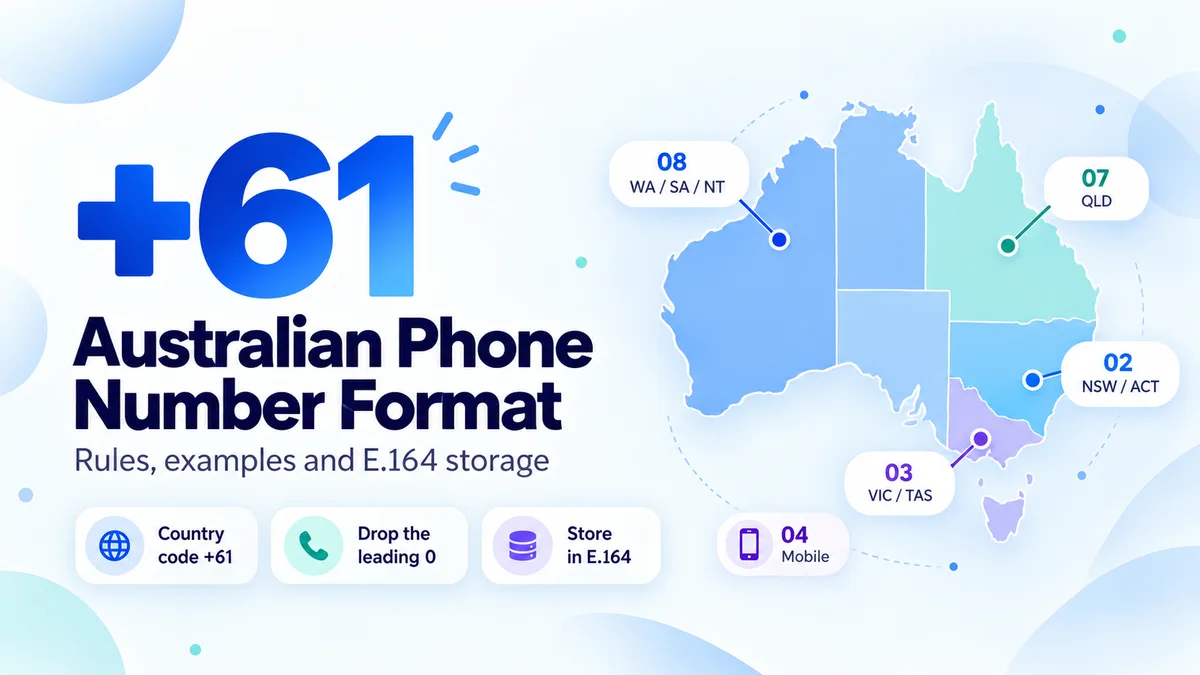
Australia+619–10 (with trunk 0)Yes — 04 for mobiles+61 2 8123 4567

Several structural differences stand out:

Trunk prefix. The UK and Australia use a leading 0 for domestic dialing that you drop when dialing internationally. The US and India have no trunk 0 — their national numbers are dialed as-is with just the country code added.

Mobile identification. The UK (07), India (6–9 lead digit), and Australia (04) all let you identify a mobile from the number itself. The US uniquely does not — mobile and landline share the same geographic format.

Length. The US and India are both cleanly ten digits in national format. The UK and Australia vary in length because their trunk 0 and variable-length area codes shift the total.

Exit codes. For calling out, exit codes differ: the UK uses 00, India uses 00, Australia uses 0011, and the US uses 011. But the plus-sign shortcut works for all of them on mobile phones, which is why E.164 storage is the universal safe choice.

The overarching lesson is that the +1 US format is one of the simplest in the world: a fixed ten digits, a single shared country code, no trunk prefix to add or remove, and no separate mobile range to track.

For teams that operate across borders, this simplicity is a reason to standardize on US virtual numbers when serving American customers. Your customers dial a familiar local or toll-free number, while your team answers from anywhere. The format your callers see is exactly what they expect, and the complexity of routing stays hidden on your side.

If you handle numbers from several countries, keep one rule above all: store everything in E.164 and format for display at the last moment. That approach absorbs every quirk in the table above — trunk zeros, variable lengths, and differing exit codes — into a single normalized field that any system can dial, text, or match without ambiguity.

Frequently asked questions

What is the standard US phone number format?

The standard US phone number is ten digits, written as (NPA) NXX-XXXX. NPA is the three-digit area code, NXX is the three-digit central office or exchange code, and XXXX is the four-digit subscriber number.

When you add the country code you get +1 (NPA) NXX-XXXX. A common written example is +1 (202) 555-0173, where 202 is the area code for Washington, D.C.

What is the US country code?

The US country code is 1. When writing a number in international format you prefix it with a plus sign, so it appears as +1 followed by the ten-digit national number.

The code 1 is shared across the entire North American Numbering Plan, which includes the United States, Canada, and around twenty Caribbean and North Atlantic territories. The area code tells the network which specific country or region the number belongs to.

How many digits is a US phone number?

A US phone number is ten digits in national format: a three-digit area code, a three-digit exchange code, and a four-digit subscriber number.

With the +1 country code included, the full international number is eleven digits. When dialing domestically for long distance, callers often add a leading 1 before the ten digits, which also totals eleven digits.

How do I dial a US number from another country?

Dial your country's international exit code, then 1 (the US country code), then the ten-digit US number.

From the UK and most of Europe the exit code is 00, so you dial 00 1 followed by the ten digits. From India the exit code is also 00. Many mobile phones let you replace the exit code with a plus sign, so saving the number as +1 followed by the ten digits works from almost anywhere.

Do US mobile phones have a different prefix from landlines?

No. The United States does not use a separate prefix to distinguish mobile numbers from landlines. Both mobile and fixed-line numbers use the same geographic area codes.

This is different from countries like the UK, where mobiles start with 07. In the US you generally cannot tell from the number alone whether it is a cell phone or a landline, because number portability lets people keep a number when switching between carriers and line types.

Why did the US switch to mandatory 10-digit dialing?

Ten-digit dialing became standard as area code overlays spread, placing more than one area code in the same geographic region. When two area codes share a region, the seven-digit local number is no longer unique, so the area code must always be dialed.

The final nationwide push came with the 988 Suicide and Crisis Lifeline. To make 988 work as a short code, areas that still allowed seven-digit dialing had to move to ten digits.

What is the format of a US toll-free number?

US toll-free numbers use the same ten-digit structure as geographic numbers, but the area code is a dedicated toll-free prefix rather than a location.

The active toll-free prefixes are 800, 888, 877, 866, 855, 844, and 833. They are dialed as 1 plus the ten digits, for example 1-800-555-0199. Toll-free numbers are not tied to any city or state, so a business anywhere can hold one.

What are N11 numbers in the US?

N11 numbers are three-digit service codes in the pattern where the first digit is 2 through 9 and the last two digits are both 1. They connect callers to specific services without a full phone number.

Examples include 911 for emergencies, 988 for the Suicide and Crisis Lifeline, 611 for phone repair, 411 for directory assistance, 311 for city services, and 211 for community and social services.

How do I get a US phone number for my business if I'm outside the US?

You can get a virtual US phone number online without a physical US office. A virtual number is a cloud-based US local or toll-free number that routes calls to your existing devices anywhere in the world.

DialPhone offers virtual US local and toll-free numbers with plans starting at $24 per user per month, free number porting if you already own a US number, and an AI receptionist to answer and route calls.

#us#phone-format#nanp#dialing#guide

About the author

Growth Operations Lead at DialPhone

Darshan leads Growth Operations at DialPhone, where he owns three interconnected programs: the comparison content operation, the open VoIP Pricing Dataset, and the test-call methodology used to verify every pricing claim published on the site.

His research process starts with hands-on product trials and live vendor quotes — not marketing pages. Pricing figures are cross-checked against actual invoices and re-verified on a rolling quarterly cycle, with the underlying dataset kept public for independent re-verification. That dataset now covers 40+ VoIP and virtual-number providers across the US and Canada market.

Darshan also leads DialPhone's AI receptionist evaluation program, running structured test-call scenarios across English, Spanish, and French to assess transcription accuracy, intent routing, and escalation behavior. Methodology notes and raw scoring are archived in the research section.

For factual corrections or dataset discrepancies, Darshan can be reached at the DialPhone editorial address. Verified corrections are published as errata with a changelog date — no silent edits.

Try DialPhone free for 14 days

AI-native business phone, SMS, meetings, and contact center on one platform. No credit card required.

Call sales Start free trial