
If you have ever seen a New York phone number on a business card and assumed the company had been around a while, the 212 area code is why.
It is the oldest phone code in New York City, it covers the smallest and densest piece of it, and for about fifteen years it has been effectively impossible to get a new one.
This guide covers what 212 actually is, where it reaches, how it relates to the three other codes sharing the same streets, why it carries the reputation it does, and what your realistic options are if you want a Manhattan number.
What area code is 212?
212 is the area code for Manhattan, New York City. It was one of the original area codes created in 1947 and originally covered all five boroughs. Today it serves Manhattan only, alongside three overlay codes — 646, 332 and 917 — that cover the exact same geography.
| Detail | Value |
|---|---|
| Location | Manhattan, New York City |
| County | New York County (coextensive with the borough) |
| Time zone | Eastern Time — UTC−5, UTC−4 in daylight saving |
| In service since | 1947 |
| Overlay codes | 646, 332, 917 |
| Nearby codes | 718, 347, 929 and 465 (outer boroughs); 917 (all five boroughs) |
| New numbers available | No unused ones since 2010 |
If a number starts with 212, it was almost certainly first issued in Manhattan — though not necessarily to the business using it now.
Where the 212 area code covers
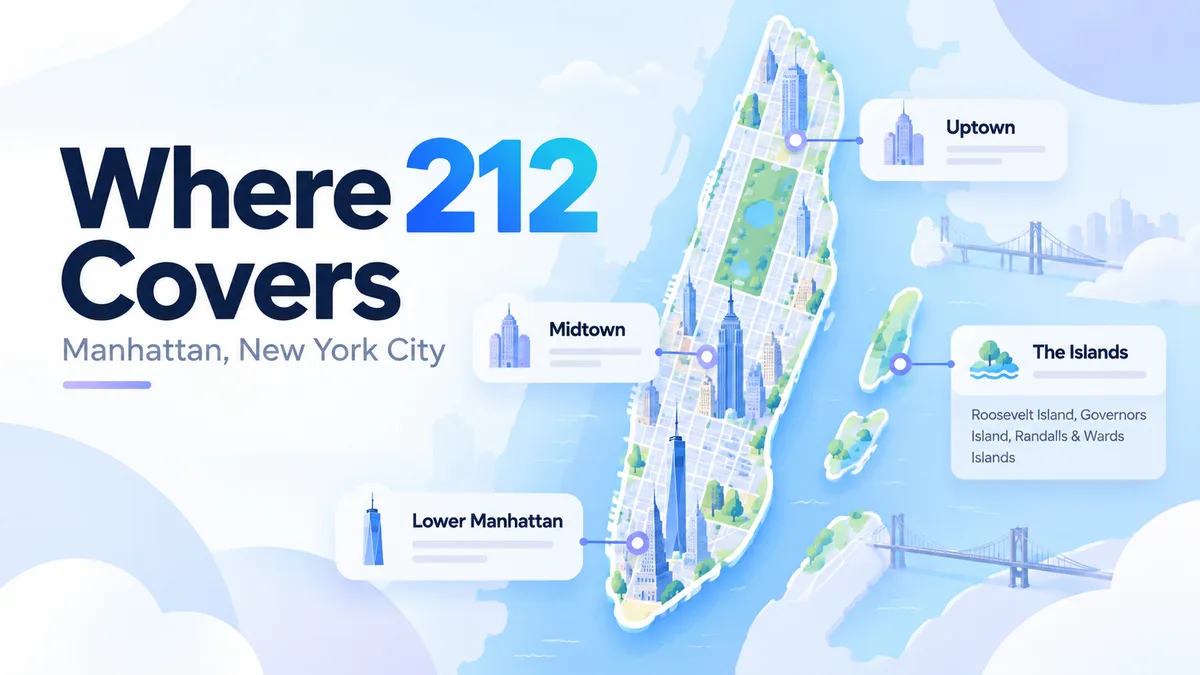
212 covers the borough of Manhattan: the island itself, plus Roosevelt Island, Randalls and Wards Islands, and Governors Island.
- Lower Manhattan
- Financial District, Battery Park City, Tribeca, SoHo, Chinatown, Lower East Side.212 · 646 · 332
- Midtown
- Midtown East and West, Times Square, Hell’s Kitchen, Murray Hill, Chelsea, Flatiron, Gramercy.212 · 646 · 332
- Uptown
- Upper East Side, Upper West Side, Morningside Heights, Harlem, East Harlem, Washington Heights, Inwood.212 · 646 · 332
- The islands
- Roosevelt Island, Governors Island, Randalls and Wards Islands.212 · 646 · 332
The other four boroughs use 718, 347, 929 and, since June 18, 2026, 465; 917 covers all five. If a New York number starts with one of those, the line is in Brooklyn, Queens, the Bronx or Staten Island — not Manhattan. That distinction matters more than most businesses expect, because a Manhattan client reading a 718 number will read it as an outer-borough company.
Manhattan’s four area codes
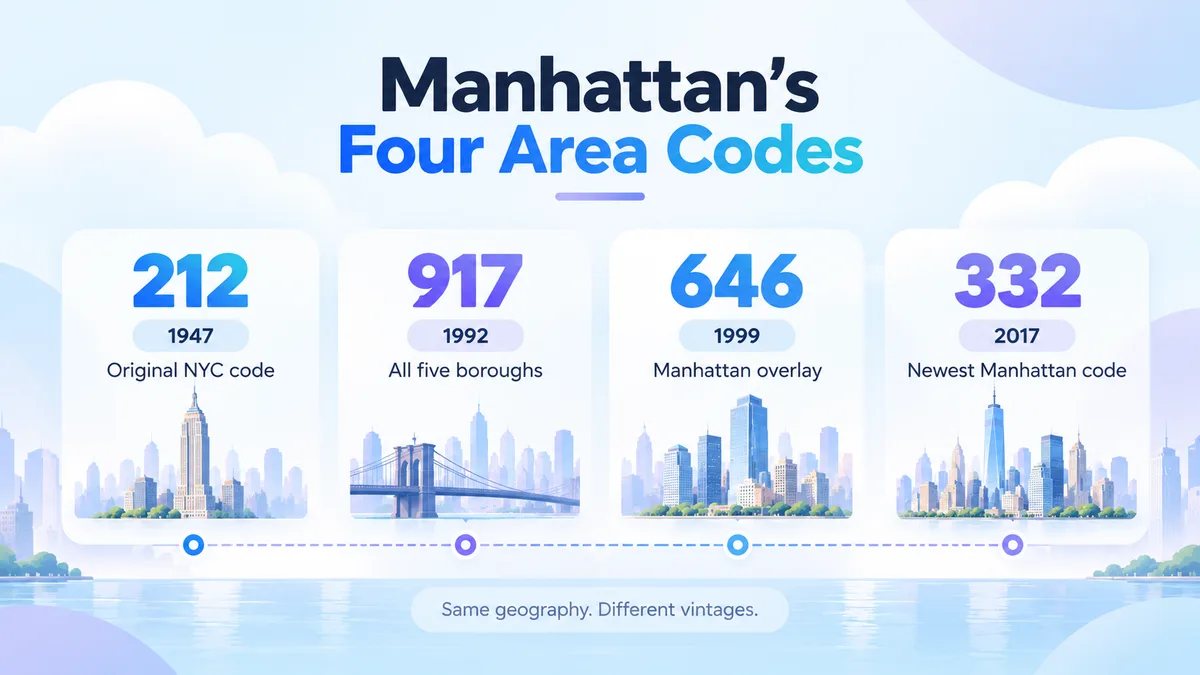
Manhattan is served by four codes that share identical geographic coverage. None is more local than another — they differ only in when they arrived.
| Code | In service | Coverage | Notes |
|---|---|---|---|
| 212 | 1947 | Manhattan | Original NYC code. No new numbers since 2010 |
| 917 | February 1992 | All five boroughs | First overlay in NANP history; originally mobile and pagers |
| 646 | July 1, 1999 | Manhattan | Added when 212 ran short. The practical default |
| 332 | June 10, 2017 | Manhattan | Newest Manhattan code; widest availability |
Because these overlap, ten-digit dialling is required for local calls in Manhattan. You cannot dial a seven-digit local number here — the exchange alone does not identify which of four codes you mean.
A short history of area code 212
Manhattan’s numbering story is the story of a city running out of numbers four separate times.
- 1947AT&T and Bell Labs assign 212 to New York City in its entirety — Manhattan, Brooklyn, Queens, the Bronx and Staten Island under a single code. There was logic to the digits: early rotary dialling took longer for higher numbers, so the busiest markets got the codes that were quickest to dial. New York received very nearly the fastest combination possible.
- September 1, 1984Growth forces the first split. Brooklyn, Queens and Staten Island move to the new 718, and 212 is cut back to Manhattan and the Bronx.
- February 1992Rather than split again, regulators try something never done before: an overlay. 917 is layered across all five boroughs, sharing territory with the codes already there, aimed initially at mobile phones and pagers. It is the first overlay in the numbering plan’s history and becomes the template for how North America has handled exhaustion ever since.
- July 1, 1992The Bronx moves to 718, along with Marble Hill. From this point, 212 means Manhattan.
- July 1, 1999646 is overlaid on Manhattan as 212 approaches exhaustion. Existing holders keep their numbers; new lines increasingly receive 646.
- 2010AT&T reports that no new 212 numbers remain to assign. Scarcity becomes permanent rather than temporary.
- June 10, 2017332 goes into service, assigned in November 2015. It is the code most new Manhattan lines land on today.
Why 212 became a status symbol
Most area codes are administrative. 212 is one of a small handful in the country that carries commercial meaning, and the reason is arithmetic rather than sentiment.
Every 212 number in use was first issued before the supply of unused numbers ran out in 2010, which is why the code reads as old Manhattan. It says less about the business than it seems: under an FCC rule adopted in 2018, a disconnected number can be reassigned to a new subscriber once it has been out of service for at least 45 days, so a 212 dates the number, not the company holding it. In finance, law, media, real estate and hospitality, where longevity is part of the pitch, it still reads as tenure.
The scarcity is genuine and closed-ended. Every 212 number that exists is already assigned to someone. There is no queue and no waiting list, because there is nothing to wait for.
Can you still get a 212 number?
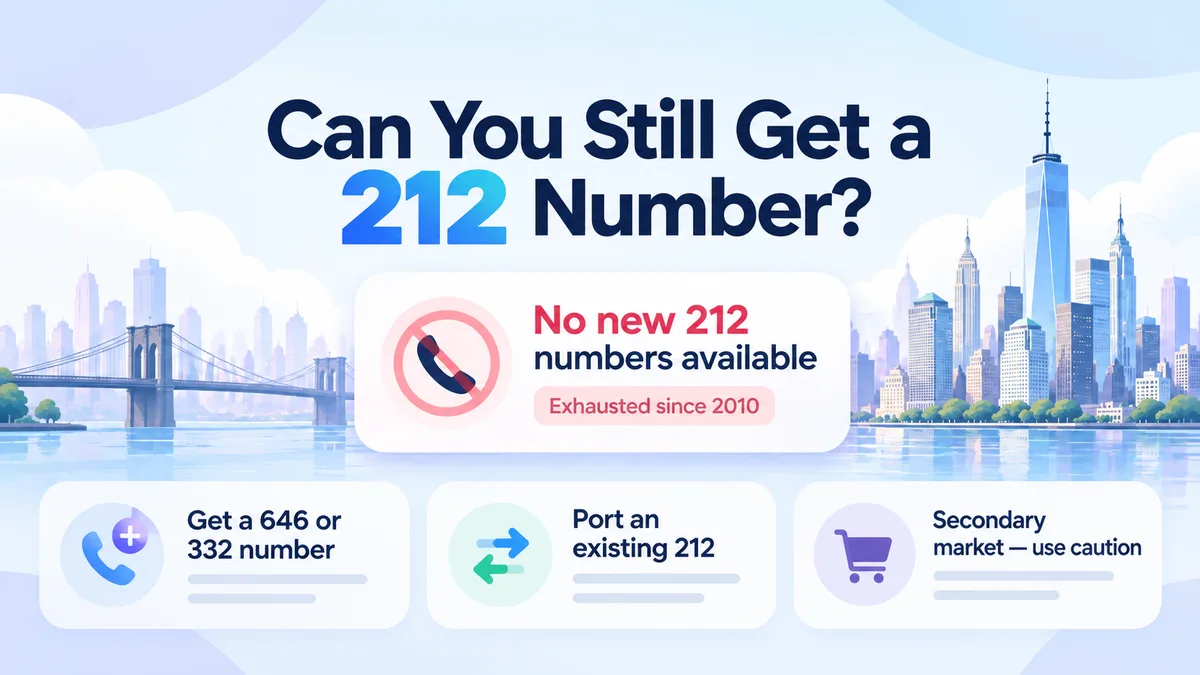
Not a new one from a carrier. Since 2010 there have been no unassigned 212 numbers to issue. Any provider offering to sell you a brand-new 212 number today is either reselling one that already exists, or describing something other than what you think you are buying.
- Take a 646 or 332 numberBoth are fully Manhattan codes covering identical geography. To anyone in New York a 646 number reads as an established Manhattan line — it has been in service since 1999. 332 is newer and has the widest availability. Neither says outer borough and neither says out of state.How numbers work
- Port a 212 number you already controlIf your business already holds a 212 line, or you are acquiring a company that does, you can move it to a new provider without losing it. Porting is a transfer rather than a reissue, which is why it is the only route to 212 that reliably works.
- Buy one on the secondary marketPossible, expensive and legally unsettled. See the caution above before committing to it.
For the large majority of businesses the honest answer is that 646 or 332 does the job, and money that would go toward a 212 on the resale market buys considerably more if it goes into how calls are actually handled.
212 vs 646 vs 332: which should you choose?
Since all three cover the same island, the decision comes down to availability and what you want the number to imply.
| If you want | Choose | Why |
|---|---|---|
| Maximum Manhattan tenure signal | 212 | Only via porting or resale — not available new |
| An established presence, obtainable today | 646 | In service since 1999; reads as long-standing |
| Best availability and memorable patterns | 332 | Newest code, largest pool of free numbers |
| A mobile-flavoured NYC number | 917 | Covers all five boroughs; historically mobile |
A practical note on vanity numbers: because 332 has the deepest unassigned pool, it is the only Manhattan code where you have a real chance of a memorable ending — a repeated digit or a clean run. If a number your customers can recall matters more than the code’s vintage, 332 is the stronger pick, and it is the one most people overlook.
212 spam and spoofed calls
The same recognisability that makes 212 attractive to businesses makes it attractive to fraudsters, and it is one of the most frequently spoofed codes in the country.
The tactic is neighbour spoofing: forging caller ID so an incoming call displays a local or well-known code, because people answer familiar numbers far more often than unfamiliar ones. A 212 number carries the added weight of looking institutional — like a bank, a law firm or a government office in Manhattan.
If an unknown 212 number has called you, three things are true at once. It may be a legitimate Manhattan business. It may be a company you already deal with, since many national firms route outbound calls through New York numbers. And it may be spoofed, with no connection to New York at all. You cannot tell which from the number alone.
212 is not a scam area code. It is a legitimate code used by tens of thousands of real businesses — the problem is impersonation of it, not the code itself. The industry answer is STIR/SHAKEN, in which the originating carrier cryptographically attests that a caller is entitled to display the number they are showing. A-level attestation is the highest, and it is why properly registered business calls are less likely to arrive marked Spam Likely.
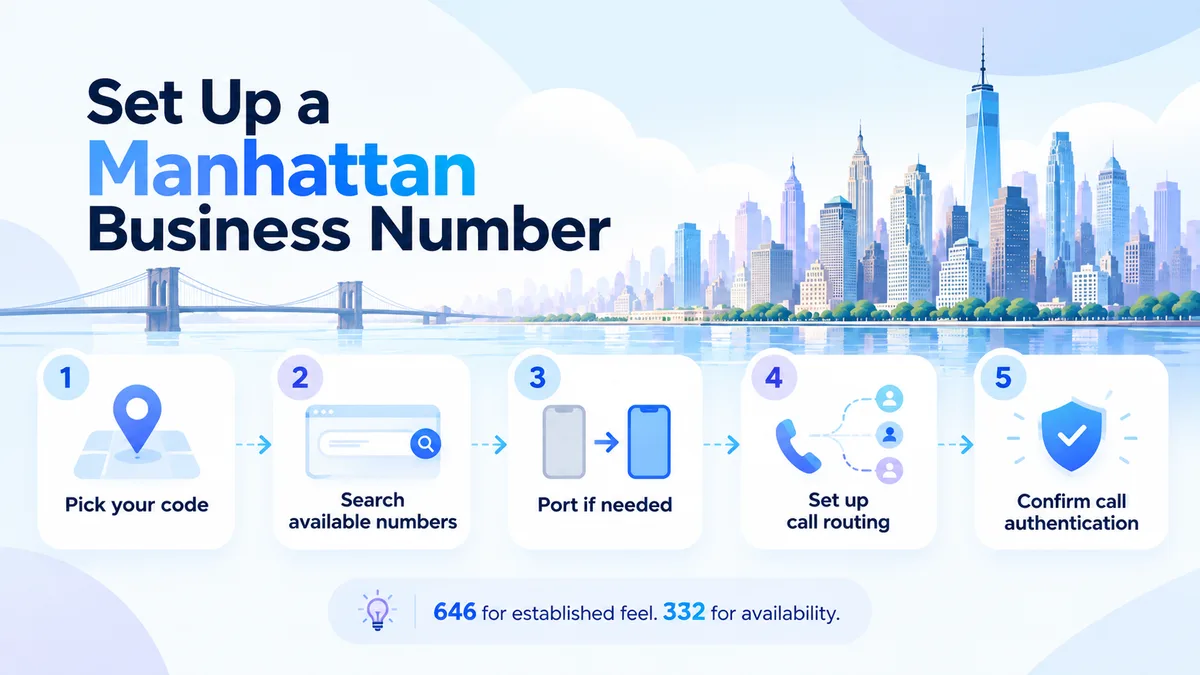
How to set up a Manhattan business number
Getting a working Manhattan line takes minutes rather than weeks, and you do not need a New York address to hold one.
- Pick your code646 for an established read, 332 for availability and memorable patterns. Both are Manhattan.
- Search the available inventoryFilter by area code, and search by pattern if a number your customers can repeat back matters to you.
- Port an existing number if you have oneYou will need a Letter of Authorization and a recent bill from your current provider.
- Set up routing before you publish the numberDecide where calls land in business hours, who they escalate to, and what happens after hours.AI receptionist
- Confirm STIR/SHAKEN attestationSo your outbound calls are less likely to be filtered as spam on the recipient’s handset.
What a Manhattan business number costs
Every provider below can issue a Manhattan number, so the number itself is rarely the deciding factor. What differs is what comes attached to it and what you pay per user each month.
| Provider | Entry plan | Per user / month |
|---|---|---|
| DialPhone | Basic | $9.99 |
| Nextiva | Core | $15 |
| Dialpad | Standard | $15 |
| MightyCall | Core | $20 |
| RingCentral | Core | $20 |
All figures are annual billing, per user, taken from each vendor’s own published pricing page as of June 2026. They are published rates, not invoice-verified, and vendors change them without notice.
Three things are worth weighing beyond the headline rate. What the entry tier actually includes, because the cheapest plan at one vendor and the cheapest at another are rarely the same product. Whether porting is charged, which matters more than the monthly rate if you already hold a number. And minimum seats and contract length — a low per-user rate on a three-year term with a five-seat minimum is not a low rate for a two-person firm.