
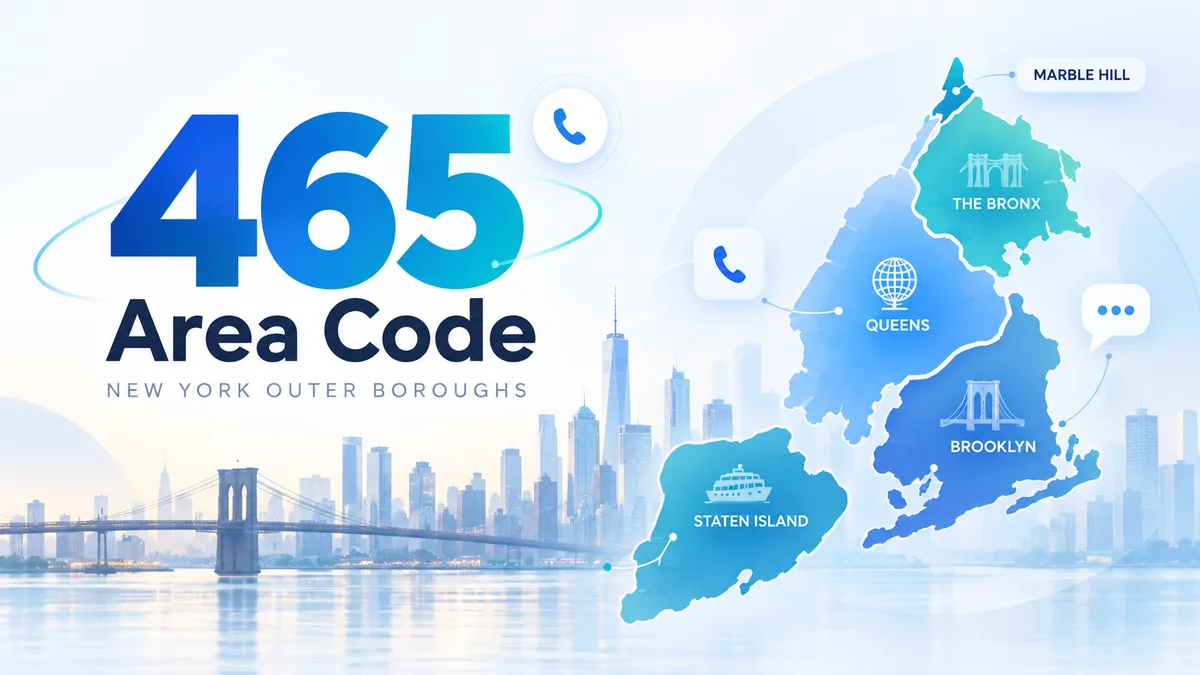
Millions of people woke up on 18 June 2026 in a city carrying one more area code than the day before.
Nothing about their phones changed. That is the point of how New York did it — and also why almost nobody noticed.
But if your business takes a new number in Brooklyn, Queens, the Bronx or Staten Island from here on, there is a fair chance it starts with three digits your customers have never seen. Whether that costs you anything is a real question with a specific answer.
What is the 465 area code?
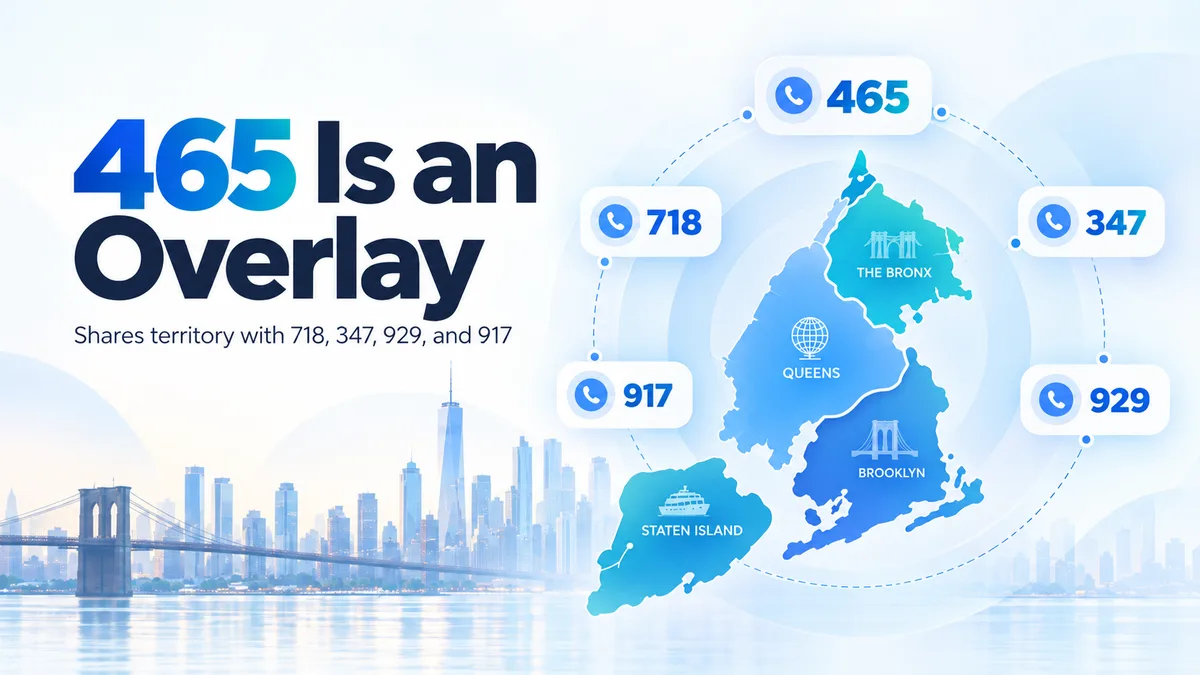
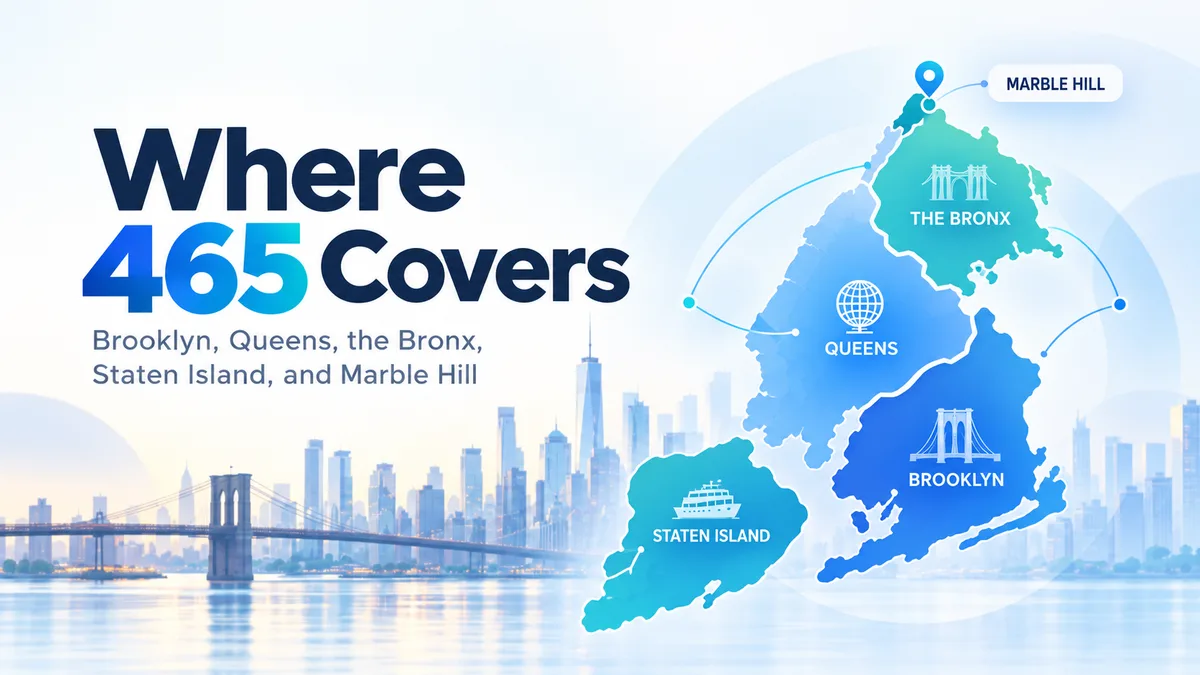
The 465 area code is an overlay serving Brooklyn, Queens, the Bronx, Staten Island and the Marble Hill section of Manhattan. It went into service on 18 June 2026 and shares its territory with 718, 347, 929 and 917.
An overlay adds a code on top of an existing region instead of splitting the map. No existing number is renumbered.
| Detail | Value |
|---|---|
| Territory | Brooklyn, Queens, the Bronx, Staten Island, Marble Hill |
| Counties | Kings, Queens, Bronx, Richmond |
| In service | 18 June 2026 |
| Shares territory with | 718, 347, 929, 917 |
| Regulator | NY Public Service Commission, Case 24-C-0314 |
| Projected supply | About 11 years |
Marble Hill, the piece that makes no sense
465 covers Marble Hill, and Marble Hill is the strangest square mile in American telephone geography.
It is legally part of Manhattan. It sits physically on the mainland, north of the Harlem River, ever since the river was rerouted in 1895 and the old channel filled.
Its phone service follows the land, not the law. Marble Hill moved to 718 in 1992, so its numbers have never matched its borough — and it can now draw a code covering four boroughs it is not in.
Why the city ran short again
Four codes already served the outer boroughs. Running dry sounds like a population story. Mostly it isn’t.
- Numbers are issued in blocks of a thousand
- Carriers draw numbers in thousand-blocks under thousands-block pooling. A carrier needing 60 numbers in a rate centre takes a block of 1,000 — and 940 sit unusable by anyone else.
- One person now holds three or four
- Desk phone, personal mobile, work mobile. Then every business line, every contact-centre seat, every fax line, every SIM in a card reader.
- Disconnected numbers don’t come straight back
- A cancelled number sits in ageing before reissue, so nobody inherits the last owner’s calls. Correct policy — and it keeps stock out of circulation for months.
The Commission ran relief planning under Case 24-C-0314 and chose an all-services overlay, with the new code projected to supply the region for about eleven years.
New York City’s area codes, in order
The city has added a code roughly every decade since the war. 465 is the latest.
| Code | In service | Territory | Note |
|---|---|---|---|
| 212 | 1947 | Manhattan | Original code. Once covered all five boroughs. |
| 718 | September 1, 1984 | Brooklyn, Queens, Staten Island | The split that cut Manhattan loose. The Bronx joined in 1992. |
| 917 | February 1992 | All five boroughs | First overlay in NANP history. Mobile and pagers. |
| 347 | 1999 | Outer boroughs | First overlay on 718 |
| 646 | July 1, 1999 | Manhattan | Added when 212 ran short |
| 929 | April 16, 2011 | Outer boroughs | Overlay on 718 |
| 332 | June 10, 2017 | Manhattan | Newest Manhattan code |
| 465 | June 18, 2026 | Outer boroughs | Overlay on 718 |
Worth pausing on 917. It was the first overlay ever used anywhere in the North American Numbering Plan, and New York tried it rather than split the city again. Overlays are the national default now. New York went first, out of necessity.
What changes for your business
Almost nothing, which is the entire argument for overlays.
- Your number stays
- No line in 718, 347, 929 or 917 is renumbered. Not now, not later.
- Your rates stay
- Local calling areas are untouched. A call between a 465 number and a 718 number down the street is the same local call it always was.
- Dialling stays
- Ten-digit dialling is already the norm in the outer boroughs, where several codes share the same ground. Keep dialling 1 plus the ten digits. 911 is still three.
- New orders may come from the new code
- That is the whole practical effect. As 718, 347 and 929 stock tightens, fresh orders increasingly draw from 465.
Will a 465 number get answered?
Here is the question worth the article. The honest answer has two halves, and the second one matters far more.
- Unfamiliarity is real, and it fades
- People answer numbers they recognise. A code nobody has seen carries no local signal yet, so some recipients treat it as unknown rather than local. 929 went through exactly this in 2011, and 347 in 1999. Both read as local now.
- But unfamiliarity isn’t what filters your calls
- What decides whether a call rings normally, lands tagged “Spam Likely”, or never rings at all is mostly not the area code. It is attestation and behaviour.
Under STIR/SHAKEN the originating carrier signs each call with a level. A means the carrier vouches you are entitled to that number. B means you are known but the number is not verified. C means it was passed along unverified. Terminating carriers feed that signal, plus your calling patterns, into the analytics engines that apply the labels.
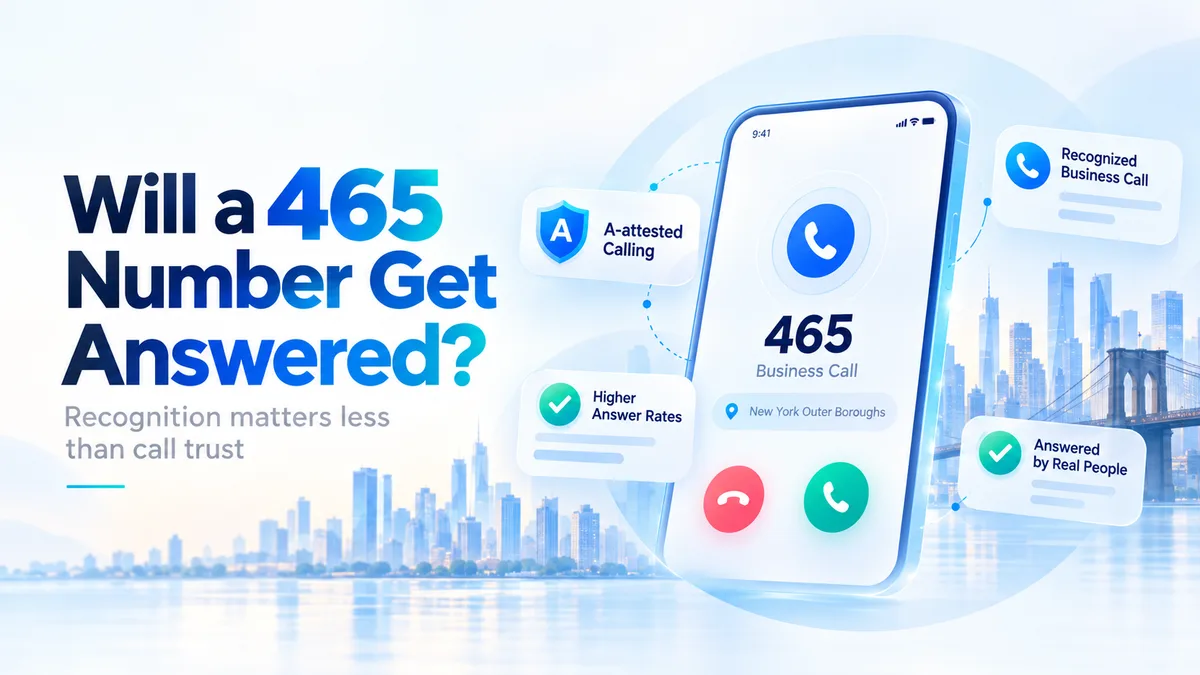
Which means the digits are the small variable. A 465 number signed A-attested from a carrier with clean behaviour will out-perform a vintage 212 pushing high-volume unanswered traffic on a C-attested route.
So a new code is a minor, fading headwind. Attestation and how you use the line are the persistent factors. If answer rates matter to you, that is where the attention belongs — not the three digits.
If you want a particular code
You can ask. You might not get it.
- Port what you already have
- Number portability means an existing outer-borough number moves with you between providers. Keeping a recognised 718 is far easier than acquiring one, and DialPhone ports numbers in for free.
- Ask what is in stock today
- One straight question — what do you hold in this rate centre right now — beats stating a preference after the order goes in.
Is a call from 465 a scam?
No more than any other code, and the assumption deserves pushback.
New codes draw suspicion precisely because they are unfamiliar, and that suspicion points the wrong way. Caller ID is forgeable. Spoofing fakes the displayed number, and the real holder usually has no idea.
A scammer wanting to look local to Brooklyn has spoofed 718 for decades — a code with far better recognition than 465 will have for years. Judge the behaviour: unsolicited urgency, a request for payment or credentials, pressure to stay on the line. A real business survives you hanging up and calling the published number back.
What to do next
465 is the outer boroughs’ fifth code. Live since 18 June 2026, it renumbers nothing, changes no rate, and should supply the region for about eleven years.
If you are taking a new outer-borough number soon, it may well start with these digits. The unfamiliarity wears off within a couple of years. What holds your answer rate up permanently is the attestation on your calls.